|
Headlines |
Jun-26 |
May-26 |
|
Monthly Index* |
550.7 |
550.9 |
|
Monthly Change* |
-0.0% |
-0.6% |
|
Annual Change |
2.2% |
1.7% |
|
Average Price (not seasonally adjusted) |
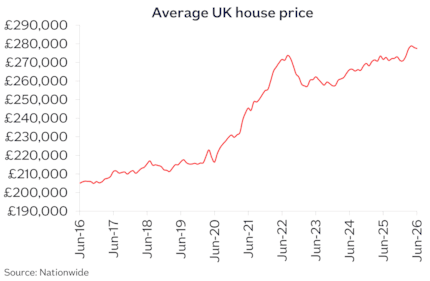
£277,484 |
£278,024 |
* Seasonally adjusted figure (note that monthly % changes are revised when seasonal adjustment factors are re-estimated)
Commenting on the figures, Robert Gardner, Nationwide's Chief Economist, said:
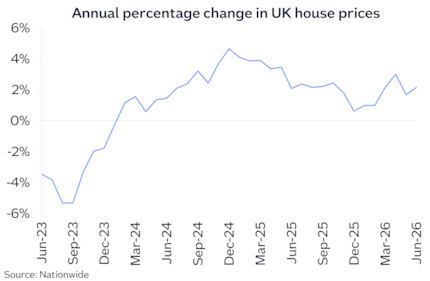
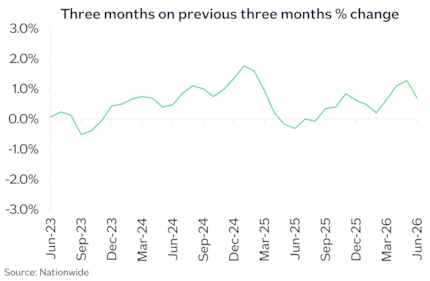
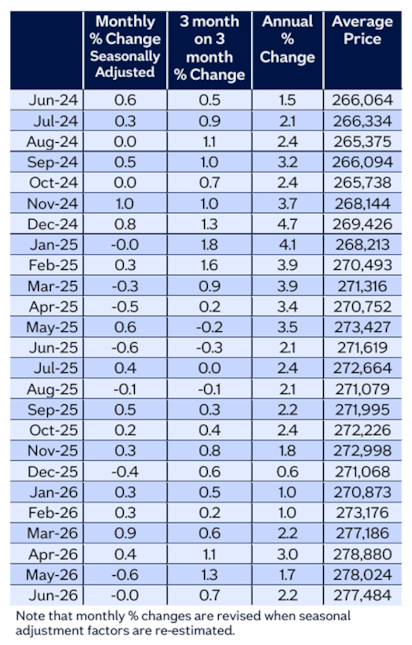
“Annual house price growth picked up to 2.2% in June, from 1.7% in May, although prices were broadly flat in month-on-month terms, after taking account of seasonal effects.
“It is not surprising that the market has softened a little in recent months, given the uncertainty caused by developments in the Middle East and the subsequent rise in energy prices and market interest rates. Indeed, consumer confidence and measures of housing sentiment have weakened, and mortgage approvals fell noticeably in May.
“While geopolitical tensions remain high, the signing of a memorandum of understanding between Iran and the US helped push oil prices back towards the levels prevailing before the conflict began.
“If the energy shock continues to subside, the Bank of England may not need to raise interest rates, or at least by less than had previously been anticipated - a view reinforced by the fact that UK inflation has also been lower than expected in recent months.
“In recent weeks a shift in market expectations for the future path of Bank Rate has helped to bring down the market interest rates which underpin fixed-rate mortgage pricing.
“If maintained, these trends will help to restore household confidence and ease affordability constraints, paving the way for a recovery in housing market activity in the coming quarters, providing that domestic political uncertainty does not adversely impact sentiment.
All regions see annual price gains in Q2
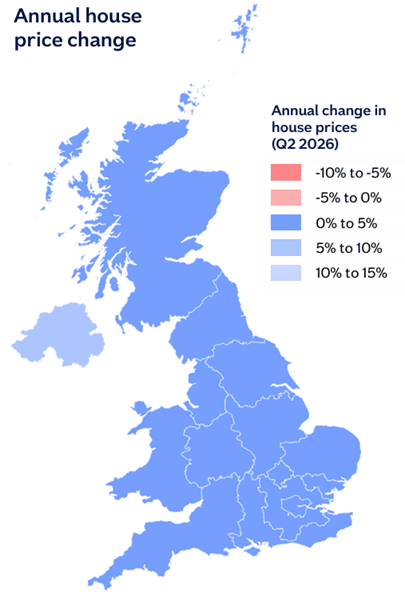
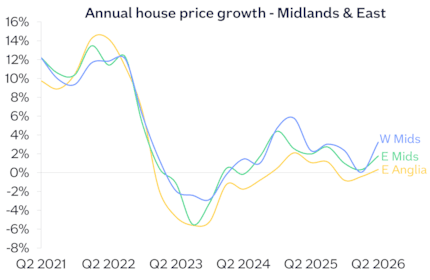
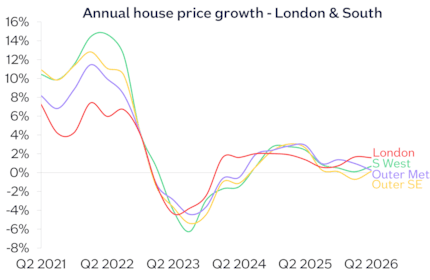
“Our regional house price indices are produced quarterly. The data for Q2 (the three months to June) indicates that all thirteen regions saw positive annual house price growth, with all but one recording growth in the 0% to 4% range.
Regions over the last 12 months
|
Region |
Average price (Q2 2026) |
Annual % chg this quarter |
Annual % chg last quarter |
|
N Ireland |
£226,699 |
8.6% |
9.5% |
|
North West |
£231,415 |
3.9% |
3.3% |
|
North |
£173,756 |
3.9% |
2.6% |
|
Scotland |
£195,928 |
3.5% |
3.0% |
|
Wales |
£220,337 |
3.5% |
2.7% |
|
West Midlands |
£256,592 |
3.2% |
0.0% |
|
Yorks & The H |
£217,518 |
2.9% |
1.6% |
|
East Midlands |
£240,482 |
1.8% |
0.3% |
|
London |
£540,903 |
1.6% |
1.7% |
|
South West |
£310,429 |
0.7% |
0.1% |
|
East Anglia |
£274,375 |
0.3% |
-0.4% |
|
Outer Met |
£432,173 |
0.3% |
1.0% |
|
Outer S East |
£341,175 |
0.1% |
-0.7% |
|
UK |
£278,784 |
2.2% |
1.5% |
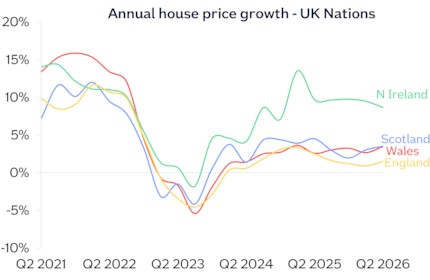
“Northern Ireland was again the exception, with price growth continuing to outpace the rest of the UK by a wide margin. Indeed, at 8.6% the rate of annual price growth was around four times faster than the 2.2% recorded in the UK as a whole (in Q2), where the strong performance echoes the trend seen in the border regions of Ireland.
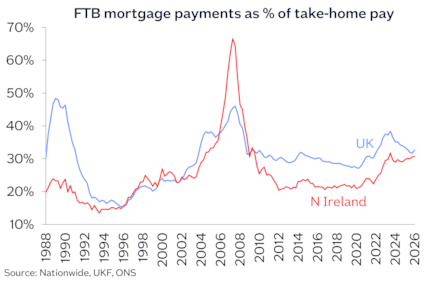
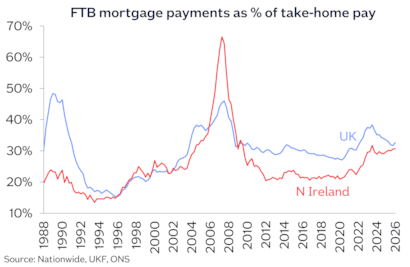
“This persistently strong performance has resulted in a deterioration in housing affordability in the region, in contrast with the UK average, which has generally been improving.
“Indeed, the mortgage payment on a typical first-time buyer property in Northern Ireland is now equivalent to 31% of an average earner’s take home pay, up from 24% in Q2 2022 - although this is still lower than the UK average of 33% (see chart below). Moreover, the price of a typical home in Northern Ireland is now around 80% of the average UK price, up from 70% in Q1 2024, but still well below the peak of 125% recorded in 2007.
“Scotland and Wales both saw a slight pickup in annual house price growth in Q2 to 3.5%, while England also saw an acceleration, albeit to a modest 1.5%, from 0.9% in Q1.
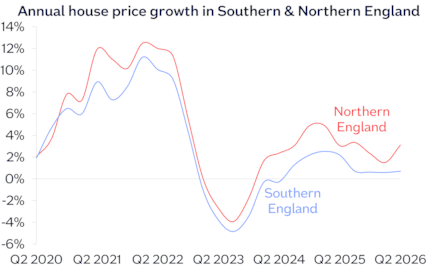
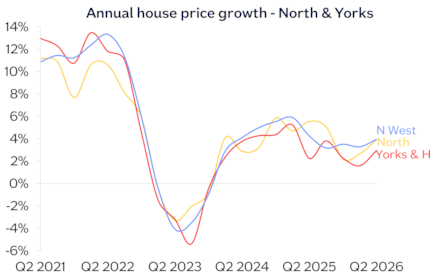
“Average prices in Northern England (comprising North, North West, Yorkshire & The Humber, East Midlands and West Midlands) were up 3.1% year on year, with the North West (which includes areas such as Cheshire, Lancashire & Greater Manchester) remaining the top performing region in England – with prices up 3.9% year on year.
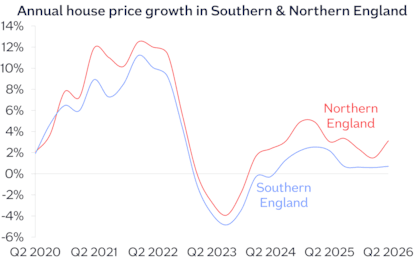
“Average house price growth in Southern England (South West, Outer South East, Outer Metropolitan, London and East Anglia) was broadly stable at 0.7%. London remained the strongest southern region, albeit with a modest annual price rise of 1.6%. Meanwhile, the surrounding Outer Metropolitan and Outer South East regions recorded even more modest rises of 0.3% and 0.1% respectively.
Nations summary table
|
Nations |
Average price (Q2 2026) |
Annual % chg this quarter |
Quarterly % chg |
|
N Ireland |
£226,699 |
8.6% |
-0.2% |
|
Scotland |
£195,928 |
3.5% |
1.1% |
|
Wales |
£220,337 |
3.5% |
0.9% |
|
England |
£315,208 |
1.5% |
0.3% |
|
UK Fact File (Q2 2026) |
|
|
Quarterly average UK house price |
£278,784 |
|
Annual percentage change |
2.2% |
|
Quarterly change (seasonally adj.) |
0.6% |
|
Most expensive region |
London |
|
Least expensive region |
North |
|
Strongest annual price change |
N Ireland |
|
Weakest annual price change |
Outer S East |
Energy efficiency ratings have limited impact on owner-occupied house prices, despite increased interest in ‘going green’
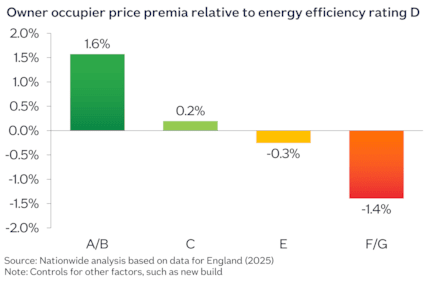
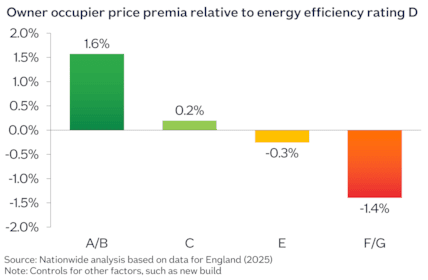
“Using data for homes in England, we examined the extent to which those buying properties pay a premium (or discount) due to the EPC rating. Our research also included other property characteristics (such as bedrooms, location and whether it is newly built) to estimate the impact on prices1.
“Our analysis suggests that a more energy-efficient property rated A or B attracts a modest premium of 1.6% compared to a similar property rated D. This is equivalent to around £4,500 based on the average house price in England. There is little difference for properties rated C or E, compared with D, as shown in the chart below. We do see a small discount for the least energy efficient properties however, with an F or G-rated home valued 1.4% lower than a similar D-rated property. This equates to around £4,000 in cash terms.
“It is interesting to note however, that energy efficiency continues to have a much greater impact on buy-to-let purchases, where an A or B-rated property attracts a 12.2% premium. For further details see our
Private Rented Energy Performance Report.
What green improvements are homeowners making?
“Our recent market research suggests around three quarters (78%) of homeowners expect buyers to pay more for an energy efficient home2. This was particularly evident amongst younger buyers, where nearly a third (32%) of those aged 25 to 34 expected buyers to pay significantly more for an energy efficient home, compared to just 5% of those aged 55+. Additionally, 69% of respondents believed that EPC ratings/energy efficiency matters more now than when they bought their home.
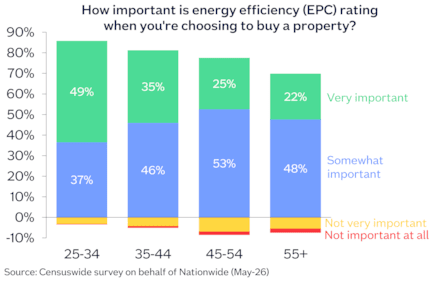
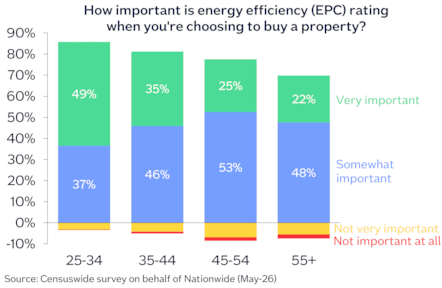
“Over half (54%) of those surveyed were not aware of their current property’s energy efficiency rating. Despite this, 77% said that EPC rating would be an important factor when choosing a property to buy in the future. Again, this appears particularly significant for younger buyers (i.e. those aged 25-34), where nearly half (49%) stated this would be ‘very important’.
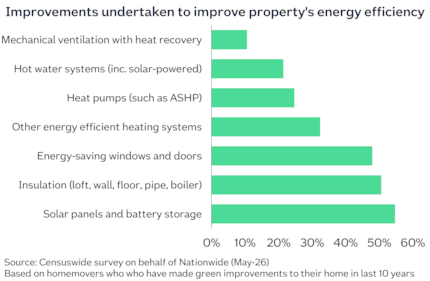
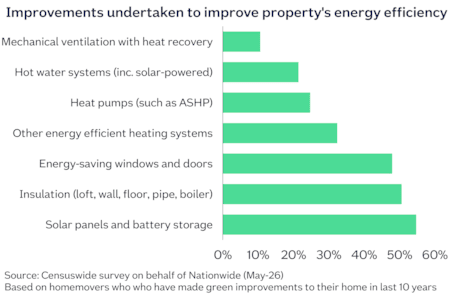
“Of homeowners who had undertaken measures to improve their property’s energy efficiency in the last ten years, the most popular were: adding solar panels, improving insulation and upgrading to energy-saving windows and doors.
“The main reasons cited for making green improvements were to reduce energy bills (60%) and to make their home more comfortable (48%). Nearly three quarters (73%) said they had seen energy bills fall as a result of the improvements they made. This is consistent with data from the Department for Energy Security and Net Zero, which suggest median equivalised fuel costs for a property rated A, B or C are around £400 per year lower versus a D-rated property and £1,200 per year lower than an E-rated property3. For further details, see our research report."
-ends-