|
Headlines |
Jan-26 |
Dec-25 |
|
Monthly Index* |
544.9 |
543.4 |
|
Monthly Change* |
0.3% |
-0.4% |
|
Annual Change |
1.0% |
0.6% |
|
Average Price (not seasonally adjusted) |
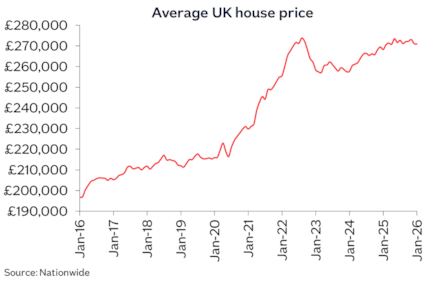
£270,873 |
£271,068 |
* Seasonally adjusted figure (note that monthly % changes are revised when seasonal adjustment factors are re-estimated)
Commenting on the figures, Robert Gardner, Nationwide's Chief Economist, said:
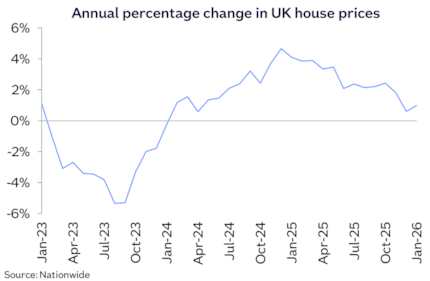
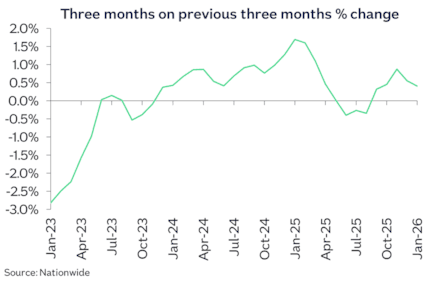
“The start of 2026 saw a slight pick-up in annual house price growth, which rose to 1.0% in January, after slowing to 0.6% in December. Prices increased by 0.3% month on month in January, after taking account of seasonal effects.
“Housing market activity also dipped at the end of 2025, most likely reflecting uncertainty around potential property tax changes ahead of the Budget. Nevertheless, the number of mortgages approved for house purchase remained close to the levels prevailing before the pandemic.
“Housing market activity is likely to recover in the coming quarters, especially if the improving affordability trend seen last year (and explored further below) is maintained.
Improved affordability supported activity in 2025
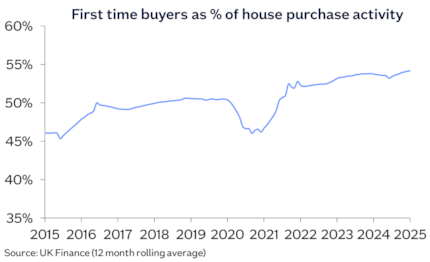
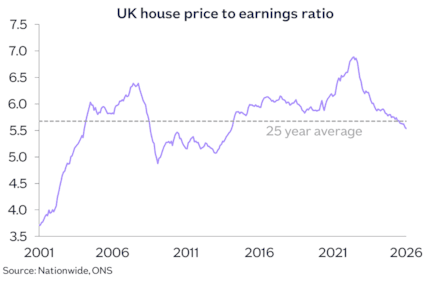
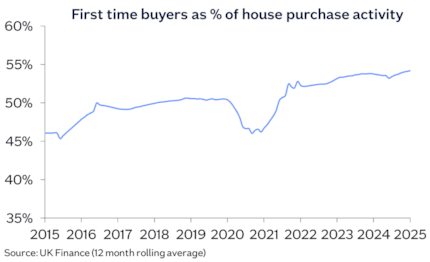
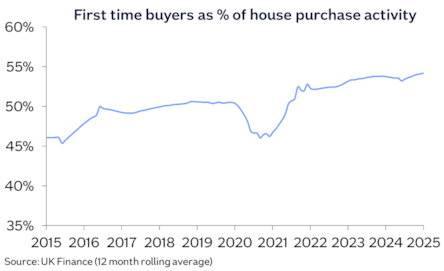
Our recent special report highlighted that affordability constraints have eased over the past year, thanks to earnings growth outpacing house price growth and also a steady decline in mortgage rates. This has helped underpin buyer demand, with first-time buyer activity over the last year continuing to edge higher as a share of house purchases.
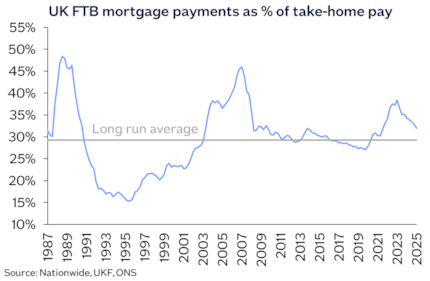
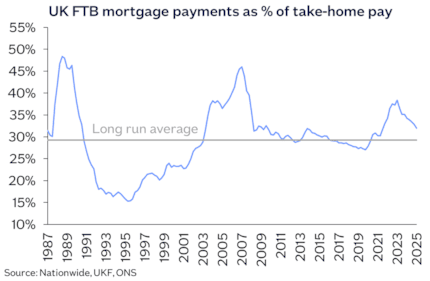
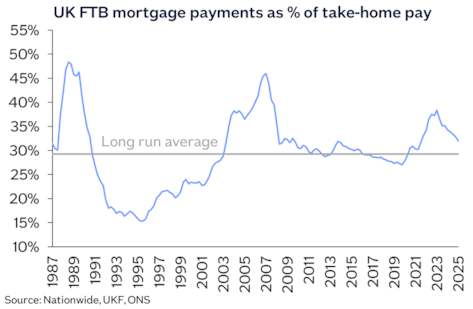
“Our main affordability benchmark shows that a prospective buyer earning the average UK income and buying a typical first-time buyer property with a 20% deposit would have a monthly mortgage payment equivalent to 32% of their take-home pay – slightly above the long-run average of 30% and well below the recent high of 38% recorded in 2023 (as shown in the chart below).
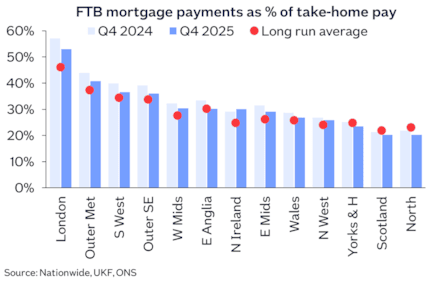
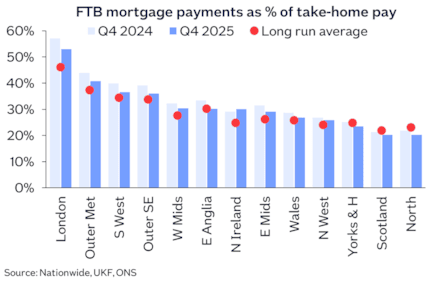
“All parts of the UK, with the exception of Northern Ireland, saw an improvement in affordability over the past year. Northern Ireland experienced a deterioration due to strong house price growth over the past year, with mortgage payments now above the long-run average in the region.
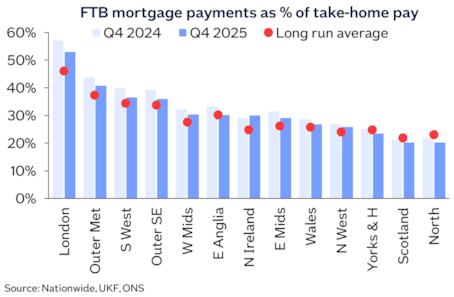
“For the second year running, London saw the largest improvement in affordability, reflecting relatively weak house price growth in 2025, solid earnings growth and lower interest rates. Nevertheless, the capital remains the least affordable region by a significant margin (see chart above).
“Affordability pressures remain pronounced in the South of England, whilst in the North, Yorkshire & The Humber and Scotland, mortgage payments as a share of take-home pay are slightly below their long-run average.
“These regional variations in affordability have led to some stark differences emerging between those who would like to buy and those that can do so.
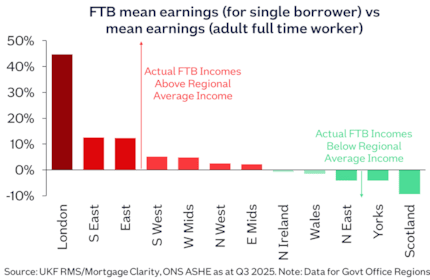
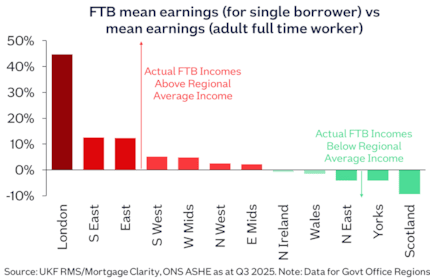
“To explore this further, we looked at how the mean earnings for actual first-time buyers compared to the regional average incomes used in our affordability benchmarks.
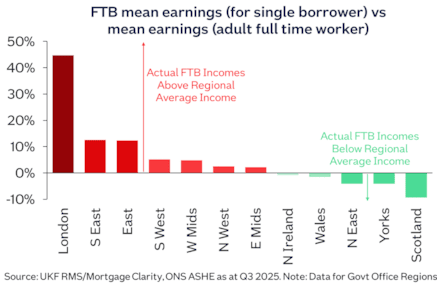
“London stands out as the area with the greatest divergence, with actual first-time buyer earnings (for a single borrower) around 45% higher than average incomes in the capital.
“But in regions where affordability is less stretched, such as the Midlands, actual first-time buyer earnings tend to be much closer to regional averages. Moreover, in a few areas, most notably Scotland, the incomes of actual first-time buyers are below the average income in the region, indicating relatively healthy housing affordability.”
-ends-