Commenting on the figures, Dan Clinton, Head of Buy to Let at The Mortgage Works, said:
Decarbonising and adapting the UK’s housing stock remains critical if the UK is to meet its net zero target by 2050, especially given that emissions from residential buildings account for 15% of the country’s greenhouse gas emissions. Government policy requiring landlords to improve the energy efficiency of their properties forms part of these efforts. Current proposals for the minimum energy efficiency standards (MEES) will require all rental properties to meet EPC band C from 2030 (subject to a cost cap and some specific exemptions).
Over half of the private rented stock is now rated A to C
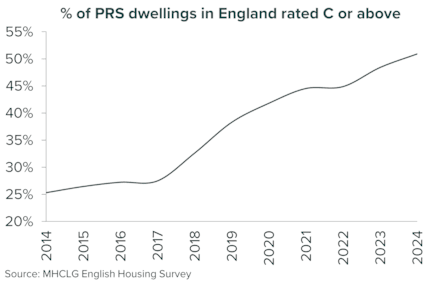
The latest data from the English Housing Survey shows that 51% of the private rented housing stock is currently rated A to C, up from 25% ten years ago. Part of the improvement is due to newly built properties, which tend to have a much higher energy efficiency rating (around 97% are rated C or above).

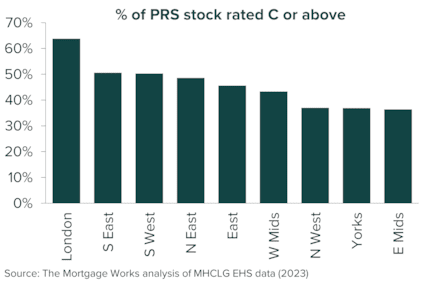
There continues to be a fair degree of regional variation in energy efficiency, especially within the PRS. London has the most energy efficient properties, with around 65% rated C or above. Meanwhile, East Midlands and Yorkshire and The Humber have the least efficient properties, with just over a third rated C or above.

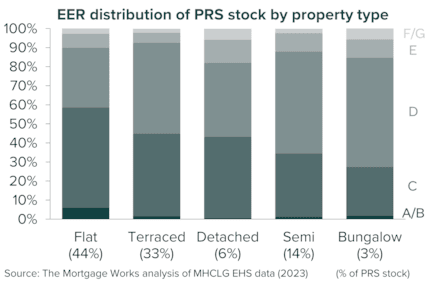
Much of the regional variation reflects the age of the stock and differences in the mix of properties. For example, London has a much higher proportion of flats, which tend to have better energy efficiency ratings than other property types. Within the PRS, 6% of flats are rated A or B, whilst a further 53% are C rated. Detached properties remained the least energy efficient within the PRS stock, with 18% rated E or worse. However, these account for a relatively small proportion (6%) of the overall PRS stock.

What value do landlords place on energy efficiency?
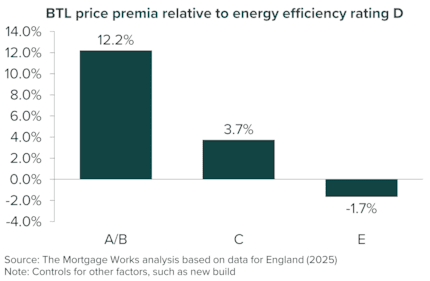
We’ve updated our analysis exploring the extent to which landlords purchasing buy-to-let properties pay a premium or discount due to energy performance. We included ratings from energy performance certificates (EPCs) alongside other observable property characteristics to estimate the impact on buy-to-let property prices. This allows us to control for other factors that can influence the value of a house or flat, such as the number of bedrooms, location and whether it is newly built.
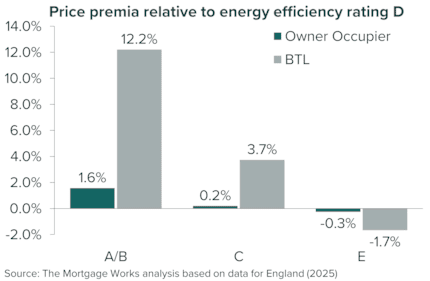
Our latest figures suggest that a property rated A or B attracts a significant premium of 12.2%, compared to a similar property rated ‘D’. This is higher than our 2024 research, which showed a 10.9% premium. C-rated properties attract a 3.7% premium, while there continues to be a slight discount for E-rated properties (1.7%).

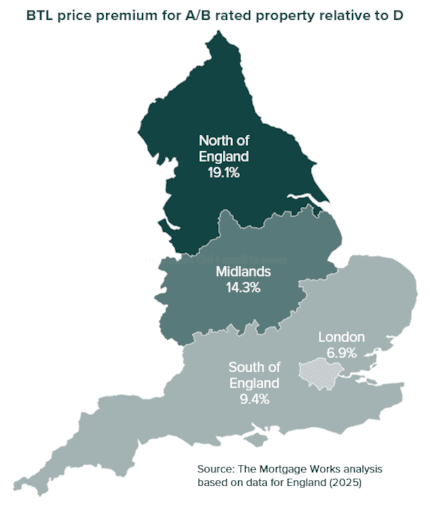
Echoing the trends seen in our 2024 research, the North of England sees the highest premium for an A or B-rated property (19.1%), whilst this remains lower in London (6.9%) and the South of England (9.4%).

The value that buy-to-let purchasers attach to more energy efficient properties continues to be significantly greater than owner occupiers (as shown in the chart below). For example, an A or B-rated house bought by someone looking to live in the property themselves only attracts a 1.6% premium.

More energy efficient properties continue to attract rental premium
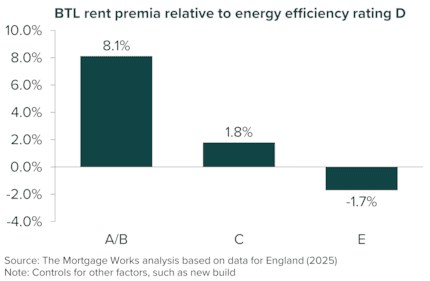
An A or B-rated property currently attracts an 8.1% rental premium compared to a similar D-rated property, up from 7.0% in our 2024 research. On our estimate of the typical rent in England (£1,075), this equates to a premium of c£85 per month. C-rated properties attract a modest 1.8% premium (c£20 per month), while there was a 1.7% discount for E-rated properties.

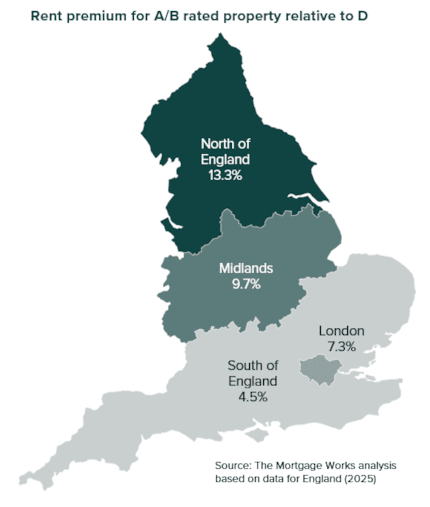
There remains considerable regional variation in rental premia, although this pattern has changed somewhat since our 2024 research. Our latest data suggests that the North of England now sees the highest rental premia, with an A or B-rated property commanding a 13% higher monthly rent. As shown earlier, the North also sees the highest property price premia for more energy efficient properties.
The South of England continues to see a more modest impact on rents from energy efficiency, with an A/B-rated property attracting a 5% premium.

Cost factors for upgrading properties to energy efficiency band C
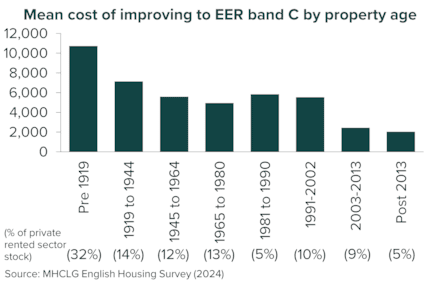
The latest government data shows that the average costs to improve older properties, particularly those built before 1919, remain significantly higher. For example, the average cost to upgrade a pre-1919 property to band C is around £10,700 (based on 2024 costs), and these make up nearly a third of the private rented stock. Properties built more recently tend to be more energy efficient, so fewer improvements are required in order to bring them up to C standard. For example, the average cost to update a property constructed between 2003 and 2013, currently rated D-G, to C standard is just £2,500.

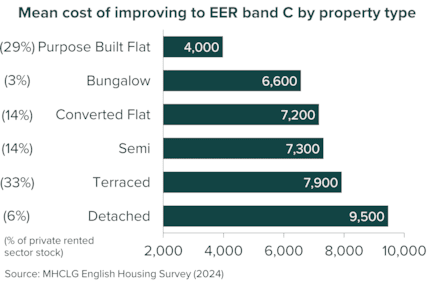
Detached and terraced houses continue to see the highest costs to improve to band C, while the cost to upgrade purpose-built flats is much lower. Again, this is likely to reflect that relatively few measures will be required to update these, given that only a very small proportion are currently rated E-G. While purpose-built flats make up nearly 30% of the private rented stock, a further third are terraced houses, which will require more investment to reach C standard.

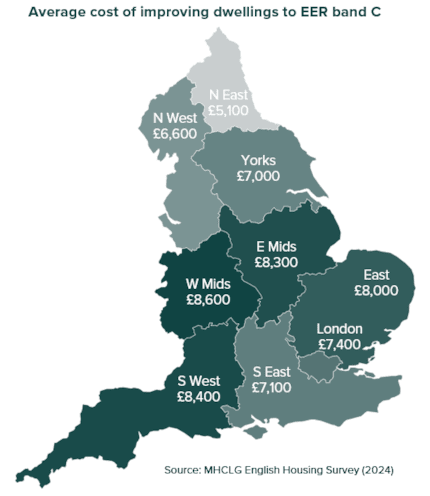
Differences in the age and property type of the housing stock by region drive variations in the average cost to update a property. The latest English Housing Survey data suggests the West Midlands and South West have the highest costs, while the costs tend to be lower in the North of England, in particular the North East.

How strong is the incentive to improve energy efficiency?
Caution is needed when comparing the costs and benefits of making energy efficiency improvements, given the significant variation seen across location, age and type of property. Nevertheless, by comparing the average costs of improvement with the impact on house prices and rents we can draw some broad conclusions.
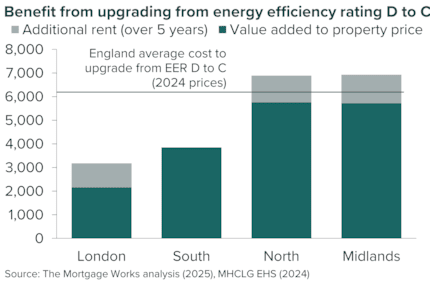
The chart below compares our estimates of the benefits associated with improving an average D-rated property to C rated with the Government’s most recent estimates (2024) of the cost of such improvements. While there is a positive impact on house prices, this is more apparent in the Midlands and North, where this equivalent to a significant proportion of the initial investment.

Combined with higher potential rents, the majority of landlords in these regions are likely to recoup the initial investment within five years (though clearly the full financial benefits would only be realised upon the sale of the property, which may also include additional costs, such as capital gains).
Our data does not suggest any rental uplift in the South of England moving from D to C, and consequently, on average, the benefits from upgrading properties here are unlikely to outweigh the costs. Whilst there is a rental benefit in London, the limited property value uplift means costs are often likely to exceed potential financial benefits.
However, forthcoming changes to MEES, mean that landlords also need to carefully consider compliance issues, particularly as breaching these regulations could result in fines up to £30,000 per breach for each property.
-ends-