|
Headlines |
Mar-26 |
Feb-26 |
|
Monthly Index* |
552.6 |
547.7 |
|
Monthly Change* |
0.9% |
0.3% |
|
Annual Change |
2.2% |
1.0% |
|
Average Price (not seasonally adjusted) |
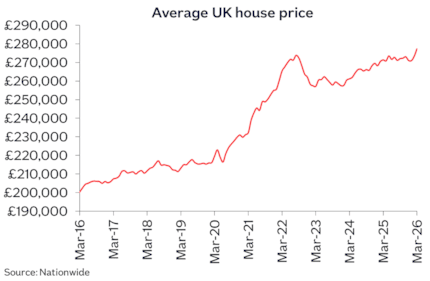
£277,186 |
£273,176 |
* Seasonally adjusted figure (note that monthly % changes are revised when seasonal adjustment factors are re-estimated)
Commenting on the figures, Robert Gardner, Nationwide's Chief Economist, said:
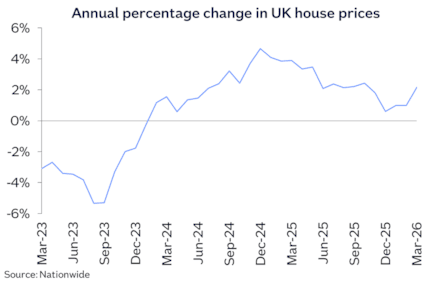
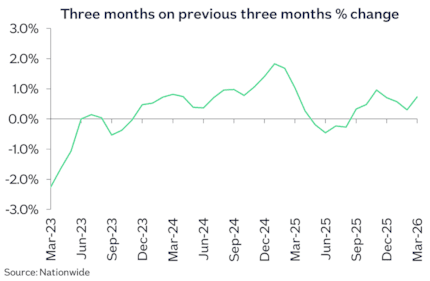
“UK annual house price growth picked up to 2.2% in March, from 1.0% in February. Prices increased by 0.9% month on month, after taking account of seasonal effects.
“The pickup in house price growth suggests that the market had regained momentum after the slowdown recorded around the turn of the year. However, the sharp rise in global energy prices in response to developments in the Middle East represents a significant shock to the global economy, clouding the outlook.
“In the near term, UK economic growth is likely to be slower and inflation higher than previously expected, although ultimately the impact will depend on the duration of the shock as well as the policy response. The outlook for interest rates is particularly uncertain and dependent on whether the demand or supply side of the economy is more adversely affected.
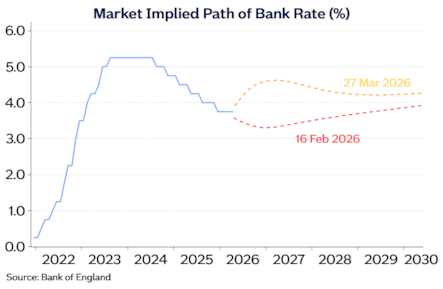
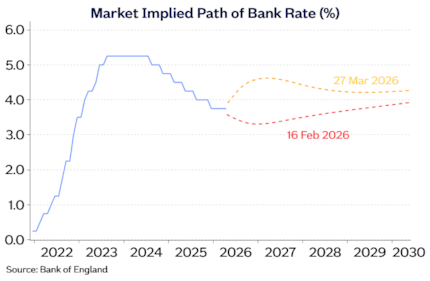
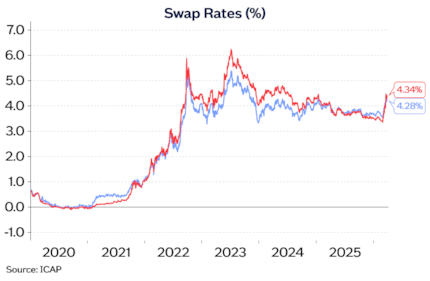
“Nevertheless, financial market expectations for the future path of Bank Rate have shifted dramatically. Towards the end of March, three interest rate increases were priced in over the next twelve months, compared to two rate cuts being anticipated before the strikes on Iran. This shift has resulted in a sharp rise in longer term interest rates (swap rates) that underpin fixed rate mortgage pricing.
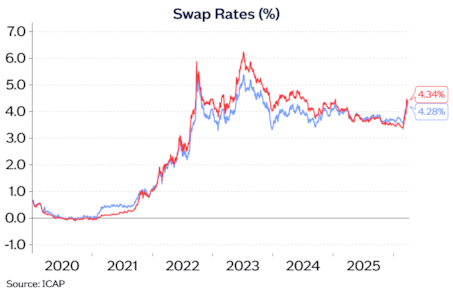
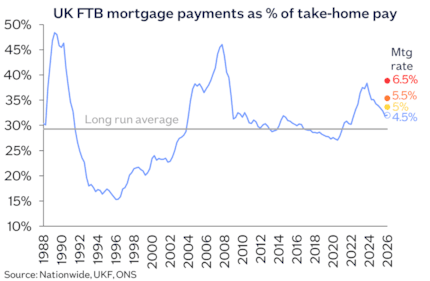
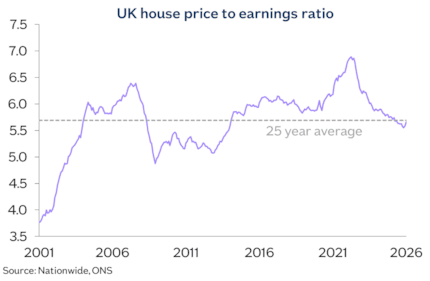
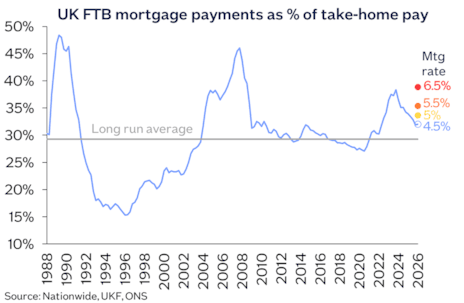
“If sustained, this could reverse some of the improvement in housing affordability that has taken place in recent years (see chart below). With consumer sentiment also likely to be dented by the uncertain outlook and the prospect of rising energy costs, housing market activity is likely to soften.
How will households weather the storm?
“The labour market has cooled markedly in recent quarters, with the unemployment rate rising towards the peak seen during the pandemic. However, this has largely been driven by people re-entering the labour force, with employment levels holding up well.
“Moreover, in aggregate, household finances are solid, with household debt at its lowest level relative to income for two decades, and significant savings buffers accumulated in recent years (though these are not evenly distributed). Hopefully this will help mitigate the additional pressures, though many are still recovering from the previous cost of living crisis.
“The vast majority of existing mortgage holders are protected from the immediate impact of higher interest rates, with c90% on fixed rate mortgages. Also, while swap rates have risen markedly, to date the increase is much less pronounced than that seen in the aftermath of the pandemic. Indeed, they are still at levels prevailing in late 2023 / early 2024 (as shown in the swap rate chart above).
Most regions continued to see modest house price growth
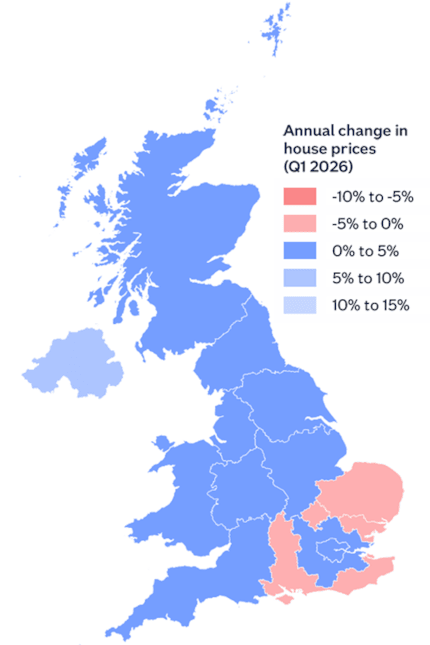
“Our regional house price indices are produced quarterly, with data for Q1 (the three months to March) indicating that most regions saw modest annual house price growth (see full table on page 4).
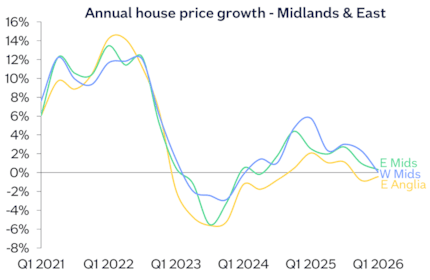
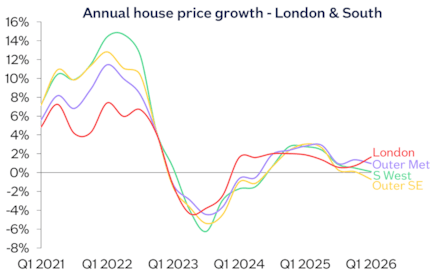
“Two of the 13 regions saw annual price declines – the weakest performing region was Outer South East (-0.7% year-on-year), followed by East Anglia (-0.4%). In addition, another three regions recorded annual growth of less than 1% (West Midlands, East Midlands and the South West).
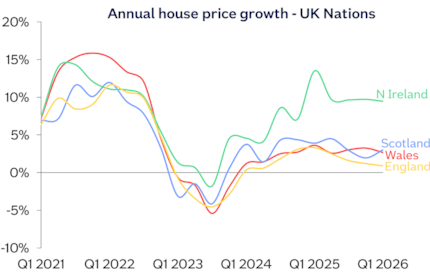
“At the other end of the spectrum, Northern Ireland continued to outpace the rest of the UK by a wide margin, with prices increasing by 9.5% over the year. This was more than six times faster than the 1.5% recorded in the UK as a whole (in Q1) and nearly three times higher than the 3.3% recorded in the next strongest region (North West). This strong performance mirrored that in the border regions of Ireland over the same period.
“Scotland saw a pickup in annual house price growth in Q1 to 3.0%, from 1.9% in Q4 2025. This was closely followed by Wales, where prices were up 2.7% year-on-year.
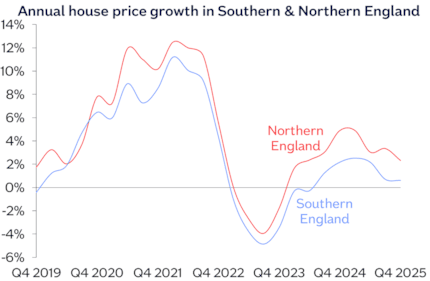
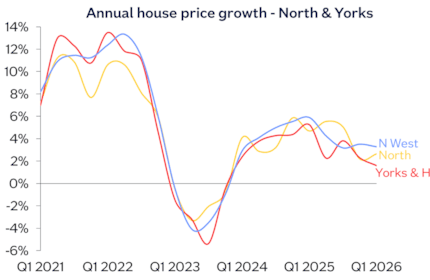
“England saw a further slowing in annual house price growth to 0.9%, from 1.2% in Q4. Average prices in Northern England (comprising North, North West, Yorkshire & The Humber, East Midlands and West Midlands) were up 1.5% year on year, with the North West (which includes areas such as Cheshire, Lancashire & Greater Manchester) remaining the top performing region in England – with prices up 3.3% year on year.
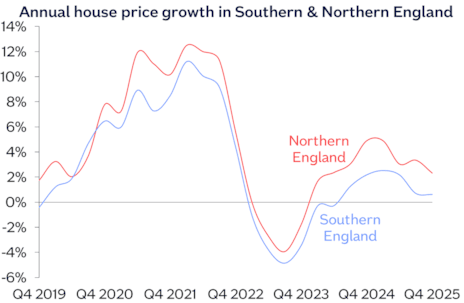
“Average house price growth in Southern England (South West, Outer South East, Outer Metropolitan, London and East Anglia) remained steady at 0.6%. London was the strongest southern region, with an annual price rise of 1.7%, up from 0.7% last quarter. Meanwhile, as noted above, East Anglia and the Outer South East both saw small annual declines.
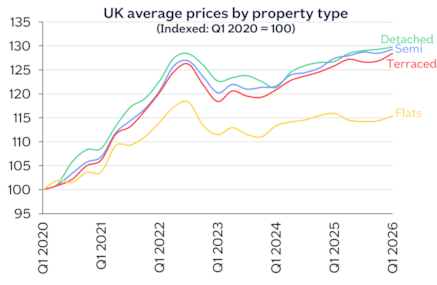
Detached properties edge ahead
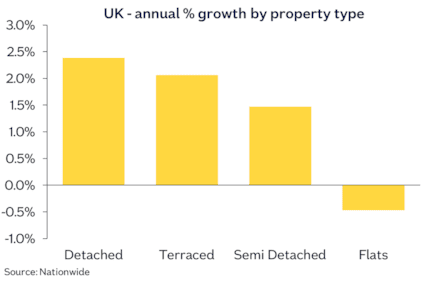
“Our most recent data by property type shows that detached properties saw the biggest percentage rise over the last 12 months, with average prices up 2.4% year on year.
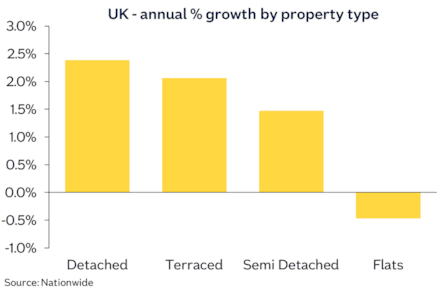
“Terraced properties saw similar growth of 2.1%, with semi-detached slightly weaker at 1.5%. However, flats saw a small year-on-year decline of 0.5%.
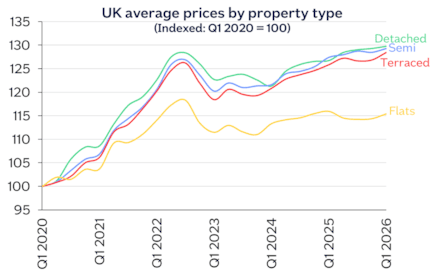
“Looking over the longer term, flats have seen noticeably weaker growth than other property types. For example, since the start of 2020, the price of a typical flat has increased by 15%, half the rise in the price of detached houses, which saw a 30% rise over the same period. This is partly a reflection of regional trends where London, which has a much greater proportion of flats, has underperformed the wider UK.”
Quarterly Regional House Price Statistics - Q1 2026
Please note that these figures are for the three months to March, therefore will show a different UK average price and annual percentage change to our monthly house price statistics.
Regions over the last 12 months
|
Region |
Average price (Q1 2026) |
Annual % chg this quarter |
Annual % chg last quarter |
|
N Ireland |
£225,269 |
9.5% |
9.7% |
|
North West |
£229,173 |
3.3% |
3.5% |
|
Scotland |
£191,747 |
3.0% |
1.9% |
|
Wales |
£215,411 |
2.7% |
3.2% |
|
North |
£170,378 |
2.6% |
2.2% |
|
London |
£538,181 |
1.7% |
0.7% |
|
Yorks & The H |
£214,866 |
1.6% |
2.3% |
|
Outer Met |
£430,260 |
1.0% |
1.4% |
|
East Midlands |
£236,016 |
0.3% |
1.0% |
|
South West |
£305,701 |
0.1% |
0.5% |
|
West Midlands |
£249,722 |
0.0% |
2.3% |
|
East Anglia |
£273,237 |
-0.4% |
-0.8% |
|
Outer S East |
£336,036 |
-0.7% |
0.1% |
|
UK |
£274,930 |
1.5% |
1.7% |
|
UK Fact File (Q1 2026) |
|
|
Quarterly average UK house price |
£274,930 |
|
Annual percentage change |
1.5% |
|
Quarterly change (seasonally adj.) |
0.7% |
|
Most expensive region |
London |
|
Least expensive region |
North |
|
Strongest annual price change |
N Ireland |
|
Weakest annual price change |
Outer S East |
Nations summary table
|
Nations |
Average price (Q1 2026) |
Annual % chg this quarter |
Quarterly % chg |
|
N Ireland |
£225,269 |
9.5% |
3.6% |
|
Scotland |
£191,747 |
3.0% |
1.5% |
|
Wales |
£215,411 |
2.7% |
0.8% |
|
England |
£311,601 |
0.9% |
0.7% |
-ends-