Commenting on the figures, Andrew Harvey, Nationwide's Senior Economist, said:
“Decarbonising and adapting the housing stock remains critical if the UK is to meet its net zero target by 2050, especially given that emissions from residential buildings account for 15% of the country’s greenhouse gas emissions.
“In this report, we analyse the latest data on the energy efficiency of the Scottish housing stock, the progress made, the motivation for and barriers to making ‘green’ home improvements.
Over half of Scottish housing stock rated A to C
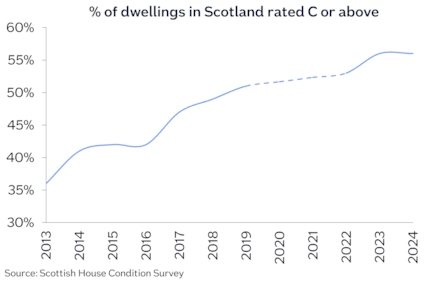
“The latest data from the Scottish House Condition Survey shows that 56% of the housing stock is currently rated A to C, up from 41% ten years ago1. Part of the improvement is due to newly built properties, which tend to have a higher energy efficiency rating, but this also reflects upgrades carried out on existing homes, such as loft and cavity wall insulation.

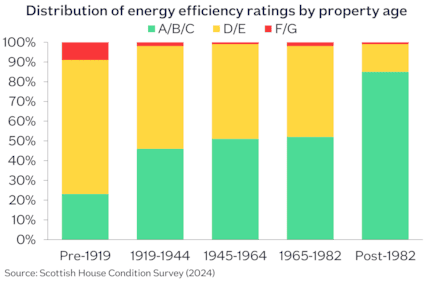
“Older properties, particularly those built before 1919, tend to have much poorer energy efficiency ratings. For example, around 77% of dwellings in Scotland built before 1919 have an EPC rating of D to G, compared to just 15% of those built after 1982.

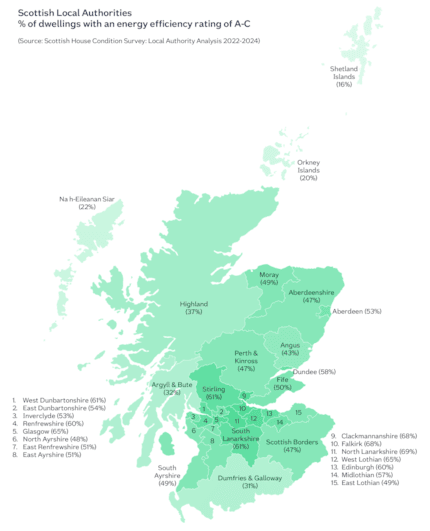
“There is also considerable variation across different areas within Scotland. Island and rural local authorities generally have less energy efficient properties, with Shetland, Orkney and the Outer Hebrides having the lowest proportion of properties rated A-C. Meanwhile, North Lanarkshire, Clackmannanshire and Falkirk are amongst the local authorities with the highest proportion of dwellings rated A to C. For further details, please see map on page 3.
“It is important to bear in mind that the characteristics of the housing stock in an area can affect energy efficiency. For example, detached houses and housing which is off the gas grid are more likely to be rated F or G, while flats are more likely to be rated A to C.
“Low carbon technologies such as air source heat pumps are expected to play a greater role in future in terms of decarbonising and improving the energy efficiency of the housing stock. However, these are currently quite a rare feature, with only 60,000 homes in Scotland using a heat pump as the primary heating system (2% of the total stock). There is a much wider uptake of solar panels however, with nearly 180,000 dwellings in Scotland having photovoltaic (PV) panels – which equates to around 8% of dwellings.
What green improvements are homeowners making?
“Our recent market research suggests that 82% of homeowners in Scotland expect buyers to pay more for an energy-efficient home2. This was more evident amongst younger buyers, where a fifth (20%) of those aged 25-34 expected buyers to pay significantly more for an energy efficient home, compared to just 4% of those aged 55+. Additionally, 70% of respondents believed that EPC ratings/energy efficiency matters more now than when they bought their home.
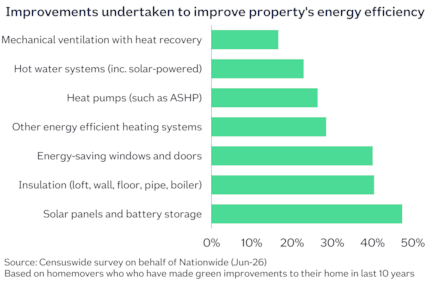
“Of homeowners who had undertaken measures to improve their property’s energy efficiency in the last ten years, the most popular were: adding solar panels (47%), improving insulation (40%) and upgrading to energy-saving windows and doors (40%).
“Adding solar panels tended to be the most expensive work undertaken, with an average spend close to £10,000, compared to around £4,500 for those improving insulation. Meanwhile, around a quarter (26%) had added a heat pump (either air source or ground source).

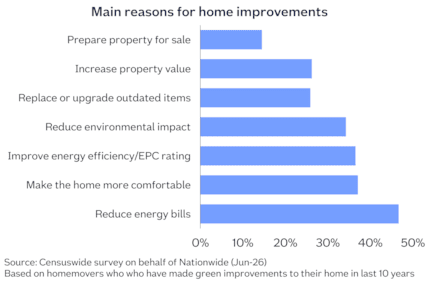
“The main reasons cited for making green improvements were to reduce energy bills (47%) and to make their home more comfortable (37%). Around two thirds (69%) said they had seen energy bills fall as a result of the improvements they made.

“Only around a quarter (26%) said the main reason for the improvements was to ‘increase the property’s value’, with 15% doing so as part of preparations for a sale. This suggests that most homeowners are mainly focused on their own benefit from the work. Indeed, 80% said they were more likely to remain in their current property longer as a result of the improvements they had made.
Reasons for not undertaking green home improvements
“Cost remains by far the biggest barrier preventing homeowners from making energy efficiency improvements, with 44% saying they simply cannot afford the upfront investment. A further 22% say that green improvements are just not a priority.
“While cost is the dominant factor, a lack of awareness and understanding is also holding people back. Nearly one in five (19%) are unsure which improvements would be most effective, while a similar number (18%) say they do not have enough information and understanding about what action to take.”
-ends-