|
Headlines |
May-26 |
Apr-26 |
|
Monthly Index* |
551.0 |
554.3 |
|
Monthly Change* |
-0.6% |
0.4% |
|
Annual Change |
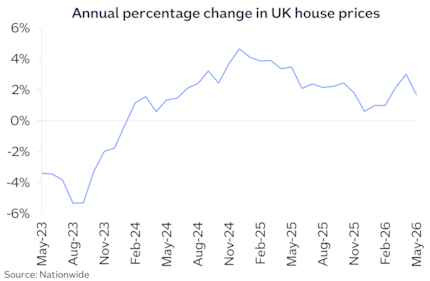
1.7% |
3.0% |
|
Average Price (not seasonally adjusted) |
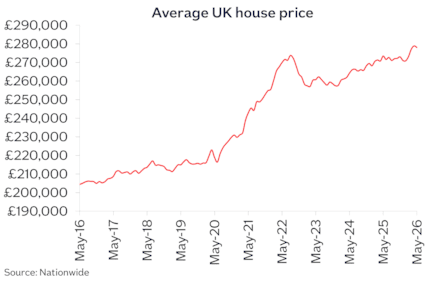
£278,024 |
£278,880 |
* Seasonally adjusted figure (note that monthly % changes are revised when seasonal adjustment factors are re-estimated)
Commenting on the figures, Robert Gardner, Nationwide's Chief Economist, said:
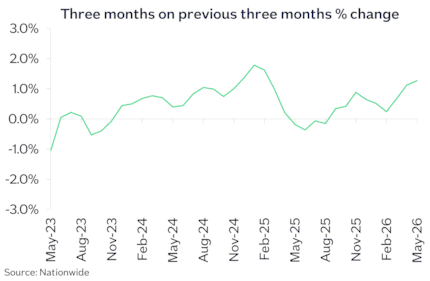
“UK annual house price growth slowed to 1.7% in May, from 3.0% in April. Prices fell by 0.6% month on month, after taking account of seasonal effects – the first monthly decline so far this year.
“Given the uncertainty caused by developments in the Middle East and the subsequent rise in energy prices and market interest rates, some loss of momentum was to be expected. Indeed, consumer confidence has weakened noticeably since the start of the conflict, with GfK’s headline index falling to its lowest level since late‑2023 in April, with only a marginal increase in May.
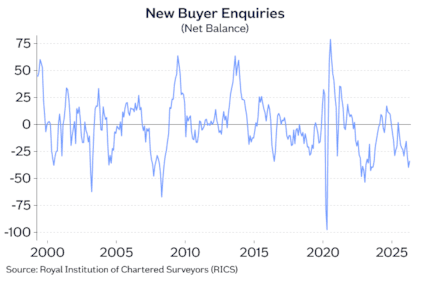
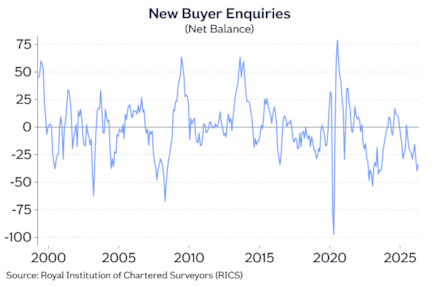
“Measures of housing market sentiment have also deteriorated. The Royal Institution of Chartered Surveyors reported a sharp fall in new buyer enquiries in March, taking the index to its weakest reading since 2023 and remained deep in negative territory in April (see chart below).
Where next?
“There has been some positive news, in that the UK economy entered this shock on a slightly stronger footing than expected. The economy grew by a healthy 0.6% quarter on quarter in the first three months of the year, while inflation softened more than expected in April.
“Nevertheless, economic growth is likely to be somewhat weaker and inflation higher than previously expected this year as a result of developments in the Middle East, although the impact will ultimately depend on the duration of the shock and the policy response.
“The UK economy and housing market have proved remarkably resilient in recent years. Household finances are solid, with total household debt at its lowest level relative to income for around two decades, and sizeable savings buffers have been built up, though these are not evenly distributed across households.
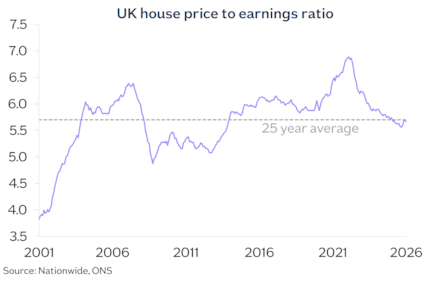
“Moreover, housing affordability had been improving steadily in recent years due to a combination of income growth outpacing house price growth by a wide margin and a modest decline in borrowing costs.
“While market interest rates have risen in recent months, the impact on affordability has so far been modest. Indeed, swap rates, which underpin fixed‑rate mortgage pricing, remain well below the highs reached in 2023 and are broadly in line with levels prevailing in 2024, implying only a partial reversal of earlier gains.
“This provides some confidence that, if the latest shock passes relatively quickly, and energy prices normalise in the quarters ahead, any near-term softening in the housing market will also prove short lived.”
-ends-